
Most of us are low in omega-3. Are you?
Find out where you stand with a simple at-home finger-prick test. The original Omega-3 Index — the method of Harris & von Schacky (2004), behind 450+ studies — analysed by GC-FID in our accredited lab. Your exact level and personalised dose, with results in 3–5 days of your sample reaching us.

The average Briton sits well below the 8–12% omega-3 index that published research links to better cardiovascular and cognitive outcomes.
The UK consistently ranks in the 'low' band of global omega-3 status maps. What you eat or supplement tells us almost nothing useful on its own — only the number in your blood does. Testing first lets you decide whether to supplement, how much, and for how long.
Sources: SACN / NHS fish-consumption guidance; Stark KD et al. (2016), Global survey of the omega-3 fatty acids in healthy adults, Progress in Lipid Research. Optimal range: Harris WS, von Schacky C (2004), Preventive Medicine.
Four tests, one drop of blood.
Every test uses the same finger-prick kit. Pick the one that matches what you want to learn.
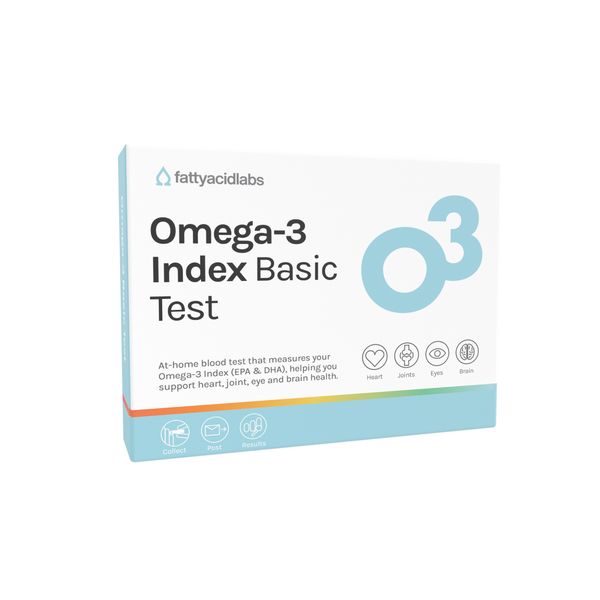
Omega-3 Index Basic
The essential omega-3 status check.
- EPA + DHA as % of total fatty acids
- Reference scale (Low / Suboptimal / Optimal: 8–12%)
- Personalised daily EPA+DHA dose
- Food and supplement guidance
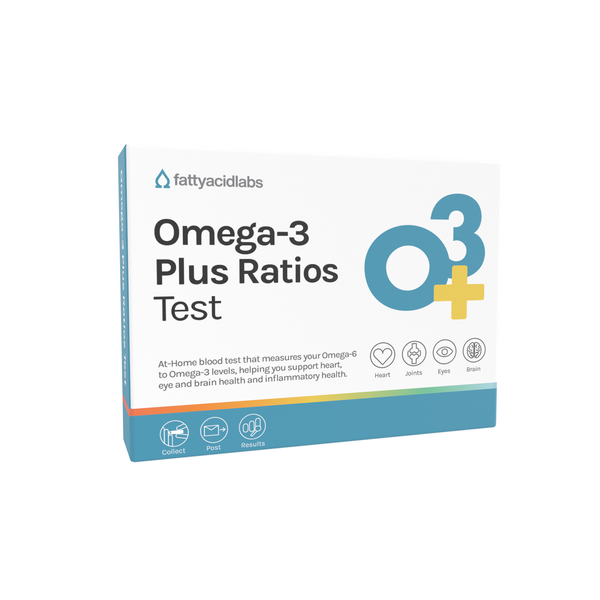
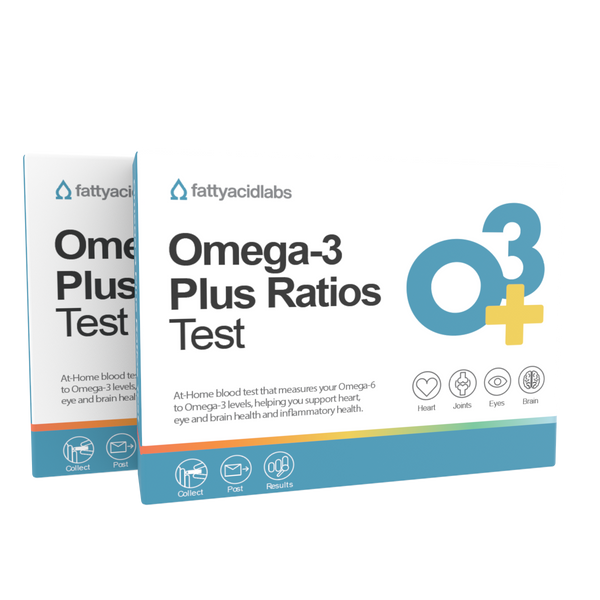
Omega-3 Plus Ratios
Index plus the ratios that signal diet patterns.
- Everything in the Index
- Omega-6 : Omega-3 and AA : EPA ratios
- Trans Fat Index
- Personalised daily EPA+DHA dose
- Food and supplement guidance
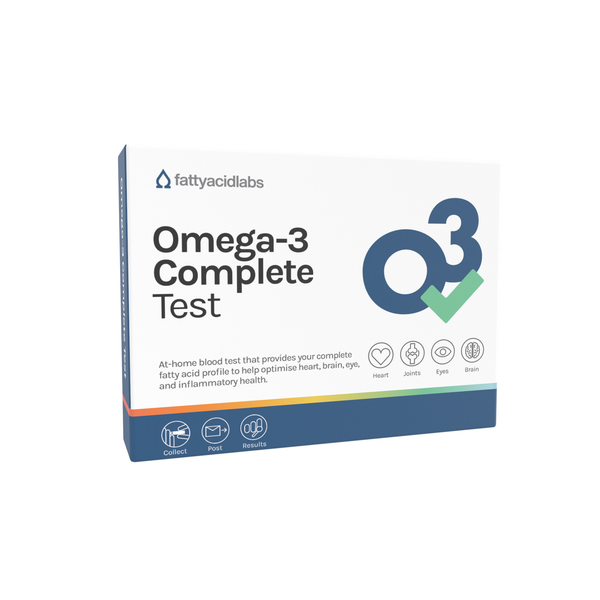
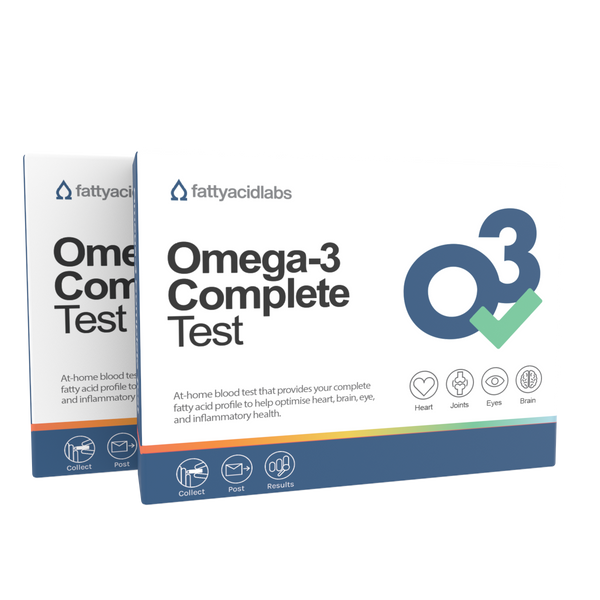
Omega-3 Complete
Your full fatty acid profile in one test.
- 24 individual fatty acids
- Full omega-3 / 6 / saturated / trans profile
- Personalised daily EPA+DHA dose
- Practitioner-friendly report

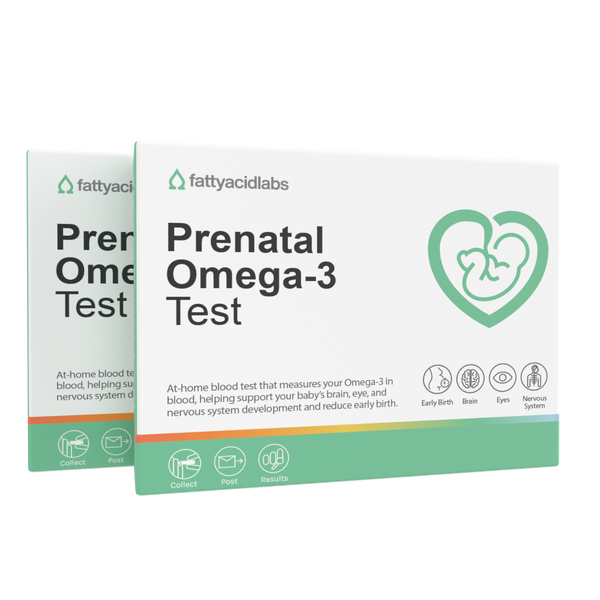
Prenatal Omega-3 Test
Omega-3 DHA monitoring through pregnancy. Same finger-prick. Pregnancy-tuned reference scale.
- Prenatal Omega-3 Index (DHA as % of total fatty acids)
- Pregnancy-tuned scale (Optimal: 4.9–8.0%)
- Personalised dose for pregnancy
- Retestable each trimester
Side by side: which test is right for you?
Same finger-prick kit, same lab. The difference is what your report tells you.
| Feature | Index Basic | Plus Ratios | Complete | Prenatal Omega-3 |
|---|---|---|---|---|
| Best for | General check | Inflammation balance | Full picture | Pregnancy |
| Omega-3 Index (EPA + DHA) | ✓ | ✓ | ✓ | — |
| Omega-6 : Omega-3 ratio | — | ✓ | ✓ | — |
| AA : EPA inflammatory ratio | — | ✓ | ✓ | — |
| Full fatty acid profile (24) See the full list → |
— | — | ✓ | — |
| Trans Fat Index | — | ✓ | ✓ | — |
| Omega-3 DHA with pregnancy reference range | — | — | — | ✓ |
| Sample report | View → | View → | View → | View → |
| Price | £49.95 | £69.95 | £79.95 | £49.95 |
| Free UK & Europe shipping | Order → | Order → | Order → | Order → |
See the full 24-fatty-acid profile measured by Omega-3 Complete
The Omega-3 Complete test quantifies 24 individual fatty acids by GC-FID, grouped into five families, plus four summary indices.
Omega-3 (4)
- Alpha-Linolenic (ALA, 18:3n-3)
- Eicosapentaenoic (EPA, 20:5n-3)
- Docosapentaenoic (DPA, 22:5n-3)
- Docosahexaenoic (DHA, 22:6n-3)
Omega-6 (7)
- Linoleic (LA, 18:2n-6)
- Gamma-Linolenic (GLA, 18:3n-6)
- Eicosadienoic (20:2n-6)
- Dihomo-γ-linolenic (DGLA, 20:3n-6)
- Arachidonic (AA, 20:4n-6)
- Docosatetraenoic (22:4n-6)
- Docosapentaenoic (DPA n-6, 22:5n-6)
Monounsaturated (4)
- Palmitoleic (16:1n-7)
- Oleic (18:1n-9)
- Eicosenoic (20:1n-9)
- Nervonic (24:1n-9)
Saturated (6)
- Myristic (14:0)
- Palmitic (16:0)
- Stearic (18:0)
- Arachidic (20:0)
- Behenic (22:0)
- Lignoceric (24:0)
Trans (3)
- Trans Palmitoleic (16:1t)
- Trans Oleic / Elaidic (18:1t)
- Trans Linoleic (18:2t)
Summary indices
- Omega-3 Index (EPA + DHA)
- Omega-6 : Omega-3 ratio
- AA : EPA ratio
- Trans Fat Index
Your GP can't measure this.
The Omega-3 Index isn't part of any routine NHS blood panel. Standard pathology measures different things — useful ones, but not your omega-3 status. Here's the gap.
Standard NHS blood panel
- No EPA + DHA measurement
- No Omega-3 Index
- No omega-6 : omega-3 ratio
- No AA : EPA inflammatory ratio
- No personalised supplement dose
Omega-3 Index Test
- EPA + DHA as % of red blood cell fatty acids
- Your Omega-3 Index on the 8–12% optimal scale
- Omega-6 : Omega-3 ratio (with Plus Ratios)
- AA : EPA inflammatory ratio (with Plus Ratios)
- Personalised daily EPA+DHA dose
Not all omega-3 tests are equal.
What separates ours: the original Harris & von Schacky method behind 450+ studies, analysed by GC-FID, every result quality-reviewed — with results in 3–5 days of your sample reaching our lab.
The original Omega-3 Index method
The validated method defined by Harris & von Schacky (2004) and used in 450+ peer-reviewed studies — the recognised marker of omega-3 status, not a generic wellness panel.
GC-FID reference method
Your sample is analysed using gas chromatography with flame ionisation detection — the reference method for fatty acid analysis, the same one used in the published omega-3 trials underpinning international clinical guidelines.
Quality-reviewed results
Every result passes through automated QC checks. Out-of-range results are reviewed by a qualified scientist before release.
Accredited lab
Sample analysis at our accredited laboratory. R² greater than 0.96 correlation with the gold-standard RBC-based Omega-3 Index method.
From letterbox to results in about a week.
No clinic visit, no fasting, no GP referral. Just one drop of blood from your fingertip.
Order your kit
Posted to your door with free UK & Europe shipping in plain packaging. Arrives in a few business days.
Collect at home
One finger-prick onto the dried blood spot card. Two minutes. No fasting, no GP needed.
Post it back
Prepaid return envelope included. Drop it in the post — fatty acids are stable on the card at room temperature.
Get your results
Full report in 3–5 days of your sample reaching our lab. Your level, your exact daily EPA+DHA dose, food and supplement guidance, and when to retest. Plain English.
Omega-3 DHA testing for the most important nine months.
Omega-3 DHA is the omega-3 your baby uses most during pregnancy — for the brain, eyes and nervous system — and a mother's level varies widely. Our at-home Prenatal Omega-3 test lets you check yours, posted across the UK & Europe, results in 3–5 days of receipt, on a pregnancy-tuned scale.
Information to know and discuss with your midwife or GP.

A real clinical report. Not a wellness summary.
Pathology-grade layout, plain-English interpretation. Built so you can read it on your own — or hand it straight to your GP, midwife, or practitioner.
-
Visual reference scale — see exactly where you sit on the optimal/suboptimal spectrum at a glance
-
Personalised dose — your exact daily EPA+DHA recommendation, tailored to your starting level
-
Food and supplement guidance — specific guidance for fish, algae, krill, or plant sources
-
Trend tracking — every retest plotted against your history so you can see what's working
-
Downloadable PDF — take it to your GP, midwife, or keep in your own health records
Find your personalised omega-3 dose.
Plug in your Omega-3 Index, your target and what you're already taking, for a daily EPA+DHA estimate based on the Walker et al. (2019) dosing model used in published research.
- Based on Walker et al. (2019) dosing model
- Works whether you supplement or not
- Free to use — no email required
Common questions
Everything you need to know before ordering.
I've read at-home blood tests aren't accurate — what's different about yours?
You're right to be cautious — at-home test quality varies hugely. The key thing about ours: it uses the original Omega-3 Index methodology defined by Harris & von Schacky (2004), the same method used in 450+ published studies. Your sample is a finger-prick blood spot, collected at home and analysed in our accredited European lab by GC-FID.
And here's what most people don't realise: you can't get an Omega-3 Index on the NHS. Standard blood panels measure cholesterol, glucose, iron — none measure EPA + DHA as a percentage of your red blood cell membranes. The only way to measure it is through a laboratory set up for fatty acid analysis.
The finger-prick is just the collection method. Your dried blood spot is analysed using GC-FID (gas chromatography with flame ionisation detection) — the reference method for fatty acid analysis, with R² > 0.96 correlation against gold-standard RBC-based analysis.
I'm already taking omega-3 — is the test still useful?
Yes — often more useful than for someone not yet supplementing. Most people on omega-3 supplements have no idea whether it's actually working. The test shows you your current Omega-3 Index, your exact daily EPA+DHA dose recommendation to hit (or maintain) the 8–12% optimal range, food and supplement guidance, and when to retest.
What's the difference between the four tests?
Index Basic measures your Omega-3 Index (EPA + DHA, optimal range 8–12%). Plus Ratios adds your omega-6 : omega-3 and AA : EPA ratios. Complete is the full 24-fatty-acid profile. The Prenatal Omega-3 Test focuses on Omega-3 DHA, with reference ranges tuned for pregnancy.
How accurate is the at-home finger-prick test?
The dried blood spot (DBS) method is well-validated for fatty acid analysis and shows R² > 0.96 correlation with the gold-standard RBC-based Omega-3 Index. Fatty acids are stable on the collection card at room temperature for several weeks, which is why samples can be safely posted across the UK and Europe without refrigeration.
What method is used to analyse my sample?
Gas chromatography with flame ionisation detection (GC-FID) — the reference method for fatty acid analysis. The same method used in the published omega-3 trials underpinning international clinical guidelines.
Do I need to fast before the test?
No. Your omega-3 status reflects intake over the previous 3–4 months — it isn't meaningfully affected by recent meals. Just avoid alcohol and intense exercise on the day of collection.
Will my GP accept these results?
Your report is formatted with the same structure you'd see from a pathology lab — analyte, methodology, reference ranges, and result. Many UK GPs, practitioners and midwives already use omega-3 results in clinical conversations. We provide information, not a diagnosis — always discuss significant results with your GP.
How long until I get my results?
Typically 3–5 days from when the lab receives your sample. We email you when your report is ready.
Stop guessing. Know your level.
A simple at-home finger-prick test, posted to your door. Free UK & Europe shipping. Results in 3–5 days of receipt.