"When should I take my fish oil — morning or night, with food or without?" It's one of the most-searched questions about omega-3, and the honest answer is reassuring: the timing details matter far less than most people think. Here's what actually moves the needle, the one timing tip genuinely worth following, and why the bigger question is whether your routine is working at all.
The short answer
For the result that matters — your Omega-3 Index — consistency beats clock-watching. EPA and DHA build into your cell membranes slowly over weeks and months, so the dose you take and how reliably you take it matter far more than whether it's 7am or 9pm. The single timing factor with real evidence behind it is simple: take it with food.
Take it with a meal that contains fat
This is the one that counts. EPA and DHA are fats, and your body absorbs them far better alongside other dietary fat, which triggers the bile and enzymes that help break them down. Studies have shown absorption can be substantially higher when omega-3 is taken with a fat-containing meal than on an empty stomach.
- Pair your supplement with your largest or fattiest meal of the day — whichever that is.
- A fat-free meal, or taking it fasted, is the worst case for absorption.
- This matters most for standard fish-oil forms (triglyceride or ethyl ester); "with food" is a safe rule for everyone.
Morning or night — does it matter?
For effectiveness, there's little evidence either way. Pick the time you'll actually remember — that's the real deciding factor. A few practical notes:
- Some people find taking it at night, or split across two meals, reduces fishy aftertaste and reflux.
- There's no need to space omega-3 away from your other supplements.
- Splitting a larger dose (half at breakfast, half at dinner) is gentler on digestion and keeps your intake steady.
How to avoid the "fishy repeats"
Reflux is the most common reason people quietly give up — and stopping is the real enemy of a good omega-3 level. To minimise it:
- Always take it with food, not before.
- Split the dose across two meals.
- Freeze the capsules, or choose enteric-coated ones, so they open further down.
- Choose a fresh, good-quality oil — rancid fish oil is a common cause of bad repeats and reduced benefit.
What matters far more than timing
It's easy to over-optimise the clock and miss the big levers. What actually determines your omega-3 status is:
- Total EPA + DHA — the combined daily amount, not the brand or the hour. Our guide to how much EPA and DHA you need walks through the numbers.
- Consistency over months — red blood cell levels take 8–12 weeks to fully reflect a change, so a few perfectly timed doses mean little; a steady habit means everything.
- The right form for you — fish, algae or krill, and concentration varies hugely. See EPA vs DHA.
The only way to know it's working
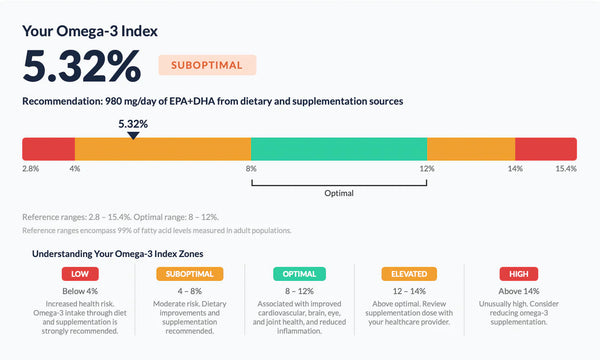
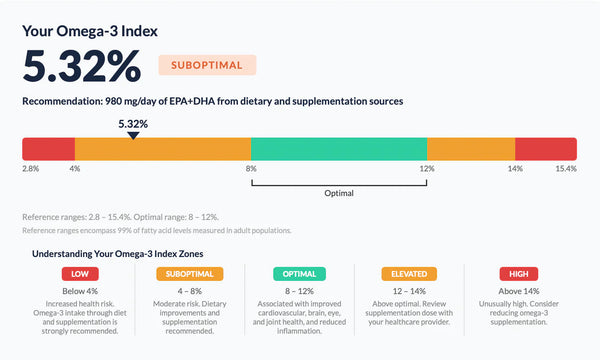
Timing tweaks are worth a few percent. Knowing your actual number is worth far more. The Omega-3 Index measures the EPA and DHA in your red blood cells — the real read on whether your supplement, dose and routine are getting you into the optimal 8–12% range, or whether something needs to change. It uses the same method as the published research (GC-FID), and it isn't part of a standard NHS blood panel — so an at-home test is the practical way to find yours.
Frequently asked questions
Should I take fish oil with or without food?
With food — ideally a meal containing some fat. Absorption of EPA and DHA is meaningfully higher with a fat-containing meal than on an empty stomach.
Is it better to take fish oil in the morning or at night?
For how well it works, there's no meaningful difference. Choose whichever you'll do consistently. Some people prefer night-time or a split dose to reduce fishy aftertaste.
Does the time I take it change my Omega-3 Index?
Barely. Your Index reflects months of intake, so total daily EPA + DHA and consistency drive it — not the hour you take your capsule.
Is the Omega-3 Index available on the NHS?
No — it isn't part of a standard NHS blood panel, which is why an at-home test is usually the practical way to find out yours.
Stop guessing whether your routine is working — measure it.
Check your Omega-3 Index — from £49.95 →References
- Schuchardt JP, Hahn A. Bioavailability of long-chain omega-3 fatty acids. Prostaglandins, Leukotrienes and Essential Fatty Acids. 2013;89(1):1–8.
- Lawson LD, Hughes BG. Human absorption of fish oil fatty acids as triacylglycerols, free acids, or ethyl esters. Biochemical and Biophysical Research Communications. 1988;152(1):328–335.
- Harris WS, von Schacky C. The Omega-3 Index: a new risk factor for death from coronary heart disease? Preventive Medicine. 2004;39(1):212–220.
This article is general information, not medical advice, and the test is not a diagnostic test. Always discuss changes to medication or supplements with your GP, particularly in pregnancy.
Know your number.
A simple at-home finger-prick test, posted to your door. Find out where you actually stand on omega-3.
See our tests