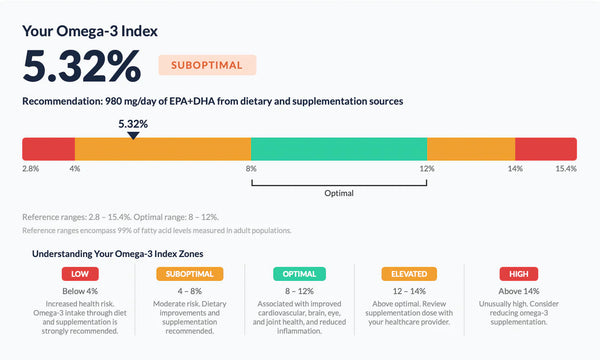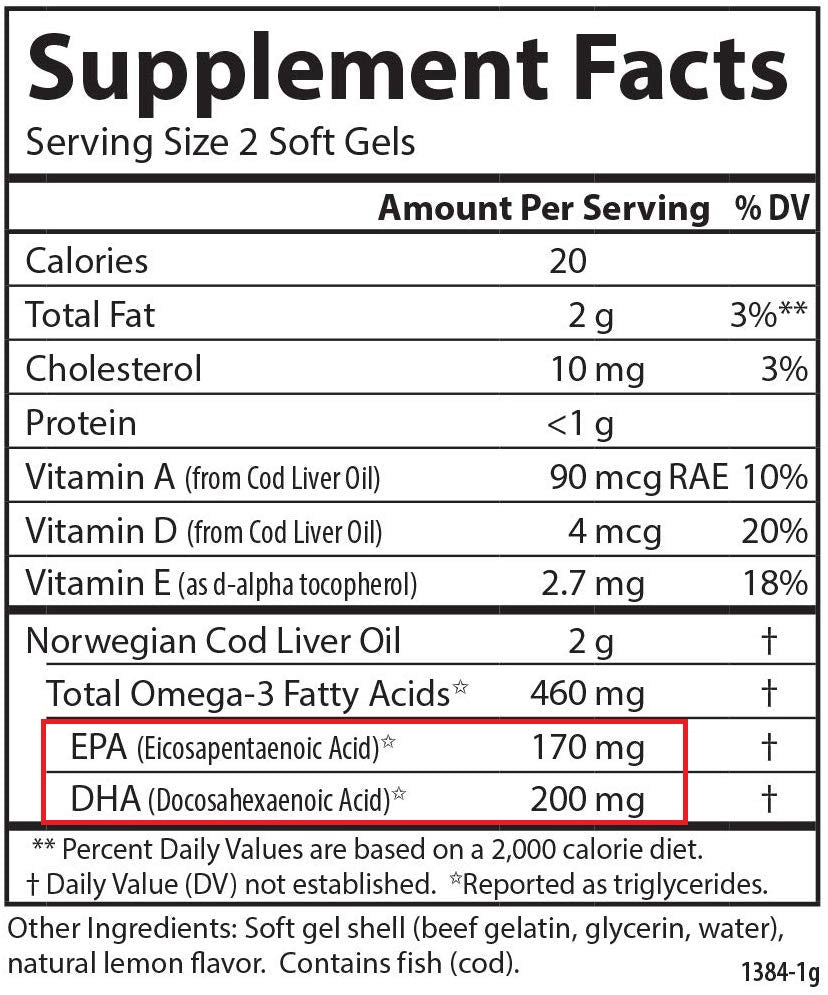
Taking a fish-oil capsule every morning feels like ticking the box. But “taking omega-3” and “having a healthy omega-3 level” are not the same thing — and the gap between them is exactly where most people go wrong.
A label tells you what went in, not what came out
A supplement label describes the dose in the capsule. It says nothing about what your body absorbed and built into your cells — which is what your Omega-3 Index actually measures. Two people taking the identical product can end up with very different blood levels, so the label is a starting point, not a result.
Why the same supplement gives different results
Several things sit between the capsule and your cells:
- Form: re-esterified triglyceride (rTG) omega-3 is generally better absorbed than the cheaper ethyl ester (EE) form.
- Whether you take it with food — a meal containing some fat improves absorption.
- Your starting level, body weight, genetics and overall diet, which all influence how far a given dose moves you.
That's why a one-size dose doesn't produce a one-size result.
The hidden-dose problem
You can be low despite supplementing daily
It's entirely possible to take a supplement every day for months and still sit in the suboptimal band — because the dose was too low, the form poorly absorbed, or your starting point further back than you realised. Without measuring, you'd never know, and you'd carry on assuming you were covered.
You can also be overspending
The opposite happens too. Some people are already comfortably in the optimal 8–12% range from diet alone, yet keep buying high-dose supplements they don't need. There's no clear benefit to pushing far above the optimal band, so testing can just as easily save you money as prompt a change.
The test – change – retest loop
The reliable way to get this right is a simple loop: test to get your baseline, change one thing (more oily fish, or a specific dose — our how much EPA and DHA guide helps you pick a number), then retest after three to four months to see whether it actually worked. Here's how to read each result.
What a measurement gives you that a label can't
A test turns “I think I'm doing enough” into “I'm at 7.1% and need a bit more”. It tells you whether to act, how much, and — crucially — whether what you're already doing is working. That's something no label, however premium, can tell you.
Frequently asked questions
If I take a good supplement, do I still need to test?
Often more so — most people on supplements have no idea whether they've reached the optimal range. A test confirms it.
How much EPA and DHA is in my supplement?
Check the supplement facts panel for total EPA + DHA, not the “fish oil” headline on the front, which is usually much higher.
How long before a new supplement changes my level?
Around three to four months, since that's how long red blood cells take to reflect the change. Retesting sooner understates it.
Could I be taking more than I need?
Yes — if you're already in the 8–12% range, there's no clear benefit to going higher, and a test will tell you.
Find out whether your routine is actually working.
Check your Omega-3 Index →References
- Walker RE, Jackson KH, Tintle NL, et al. Predicting the effects of supplemental EPA and DHA on the omega-3 index. American Journal of Clinical Nutrition. 2019;110(4):1034–1040.
- Harris WS, von Schacky C. The Omega-3 Index: a new risk factor for death from coronary heart disease? Preventive Medicine. 2004;39(1):212–220.
This article is general information, not medical advice, and the test is not a diagnostic test. Always discuss significant health decisions, or any changes to medication or supplements, with your GP.
Know your number.
A simple at-home finger-prick test, posted to your door. Find out where you actually stand on omega-3.
See our tests