If you live in the UK, the odds are that you're low in omega-3 — and you'd have no way of knowing without measuring. Britain sits near the bottom of the international omega-3 rankings, and the gap between what we're advised to eat and what we actually eat is wide. Here's what the data shows, why it happens, and how to find out where you personally stand.
What ‘low in omega-3’ actually means
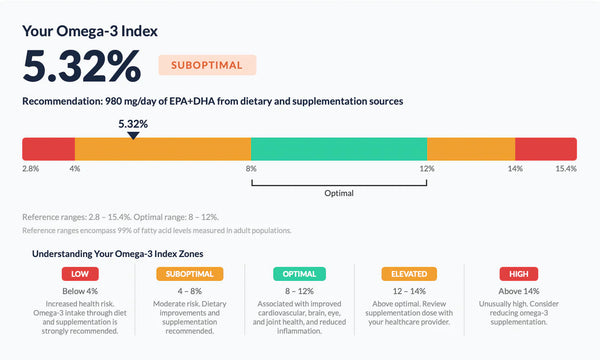
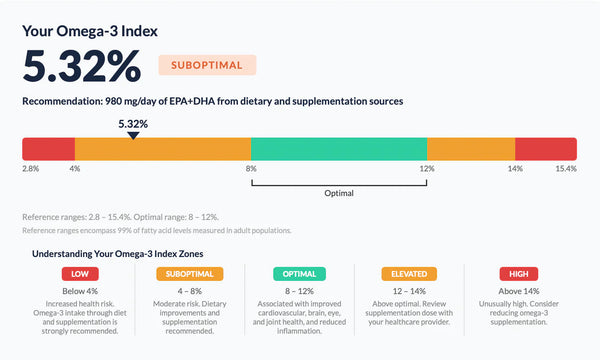
The clearest way to describe omega-3 status is the Omega-3 Index — the percentage of EPA and DHA in your red blood cells. A level of 8–12% is considered optimal; below 4% is the lowest band. Most UK adults land in the suboptimal 4–8% zone. So “low” isn't a vague wellness phrase here — it's a measurable position on a validated scale.
How the UK compares internationally
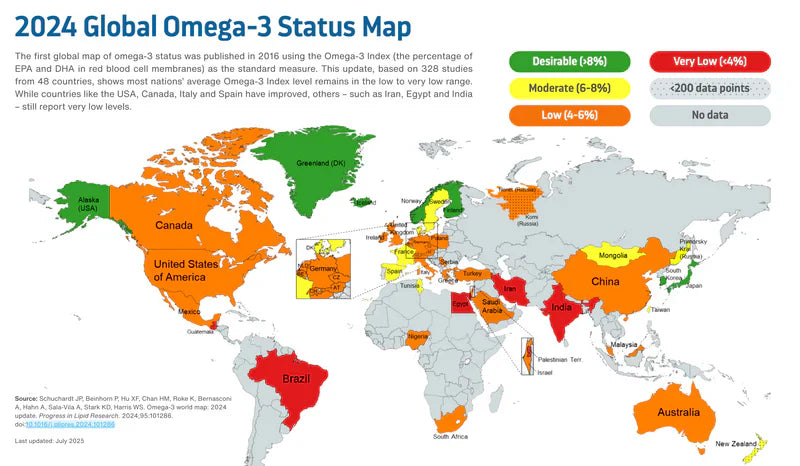
A global survey of blood omega-3 levels by Stark and colleagues (2016) mapped omega-3 status across dozens of countries. The pattern was stark: populations that eat a lot of oily fish — Japan, South Korea, parts of Scandinavia — cluster in the higher, 8%-plus bands, while the UK, Ireland, much of Western Europe and North America sit in the low band, frequently around 4–6%. In other words, low omega-3 status in the UK isn't an individual failing; it's the national baseline.
What the UK is actually advised to eat
The Scientific Advisory Committee on Nutrition (SACN) and the NHS recommend at least two 140g portions of fish a week, one of which should be oily (salmon, mackerel, sardines, herring or trout). That broadly equates to a population-average target of around 450mg of combined EPA and DHA per day. It's sensible advice — but national diet surveys consistently show average oily-fish intake well below one portion a week, and a large share of adults eat none at all.
Why the gap exists
Several things pull in the same direction. Oily fish has slipped out of the typical British weekly shop, replaced by convenience foods. Modern diets are simultaneously high in omega-6 fats from vegetable and seed oils, shifting the overall omega-6 to omega-3 balance. And cost, taste, smell, cooking confidence and sustainability worries all nudge people away from oily fish. The result is a population that's drifted steadily lower over decades.
Why it's worth caring about
A higher Omega-3 Index has been associated, in large observational studies, with better cardiovascular and cognitive markers, and the British Heart Foundation includes oily fish as part of a heart-healthy eating pattern. The honest caveat is that much of this evidence is associative rather than proof of cause, and omega-3 is not a treatment for any condition. But the UK intake gap is real, and what the evidence says on omega-3 and heart health is worth reading in full.
The supplement blind spot
Plenty of people take a daily fish-oil capsule and assume they're sorted. The problem: supplements vary enormously in how much EPA and DHA they actually contain and how well your body absorbs them, so two people on “the same” supplement can end up at very different levels. Taking something is not the same as reaching the optimal range — and the only way to know which side of the line you're on is to measure. If you want to estimate a target dose, our guide to how much EPA and DHA you need runs through it.
How to find your own number
You don't need a GP referral or a clinic visit. A finger-prick dried blood spot, posted to the lab and analysed by gas chromatography (GC-FID), returns your Omega-3 Index on the same scale used in the research. From there you can decide — with your GP where relevant — whether to change anything, by how much, and retest in a few months to confirm it worked.
Frequently asked questions
How much omega-3 do most UK adults get?
Less than recommended. Average oily-fish intake sits below the SACN/NHS guidance of two portions a week (one oily), and many adults eat none at all.
What counts as a healthy omega-3 level?
An Omega-3 Index of 8–12% is the optimal range. Most UK adults fall in the suboptimal 4–8% band.
Can I rely on diet alone?
It's possible with regular oily fish, but most people don't eat enough to get there. A test is the only way to confirm whether your diet is doing the job.
Does the NHS measure omega-3?
No — the Omega-3 Index isn't part of standard NHS blood panels, so an at-home test is the usual route.
Find out which side of the line you're on.
Check your Omega-3 Index →References
- Stark KD, Van Elswyk ME, Higgins MR, et al. Global survey of the omega-3 fatty acids in the blood of healthy adults. Progress in Lipid Research. 2016;63:132–152.
- Scientific Advisory Committee on Nutrition (SACN). Advice on fish consumption: benefits and risks. 2004; and NHS Eatwell guidance.
- Harris WS, von Schacky C. The Omega-3 Index: a new risk factor for death from coronary heart disease? Preventive Medicine. 2004;39(1):212–220.
- British Heart Foundation — oily fish and heart-healthy eating guidance.
This article is general information, not medical advice, and the test is not a diagnostic test. Always discuss significant health decisions, or any changes to medication or supplements, with your GP.
Know your number.
A simple at-home finger-prick test, posted to your door. Find out where you actually stand on omega-3.
See our tests