Omega-3 and heart health is one of the most studied — and most debated — areas in nutrition. Headlines swing between “fish oil saves lives” and “fish oil does nothing”, which helps no one. Here's a calm, honest summary of what the evidence actually supports, what's still uncertain, and where your Omega-3 Index fits.
Why omega-3 and the heart are connected at all
EPA and DHA are built into cell membranes throughout the body, including the heart and blood vessels. Omega-3 intake is studied in relation to blood triglyceride levels, heart rhythm, blood pressure and inflammatory balance. That biological plausibility is why researchers have looked so hard at the question — but plausibility isn't proof, so it's worth separating what's established from what isn't.
What the observational evidence shows
Across large population studies, a higher Omega-3 Index has been consistently associated with lower cardiovascular risk, and the Index was originally proposed by Harris and von Schacky precisely as a risk marker. People who eat more oily fish tend to have better cardiovascular outcomes on average. The important word is associated: these studies show a relationship, not definitive cause and effect.
What the clinical trials show
Randomised trials — the stronger form of evidence — are genuinely mixed. Broad, lower-dose supplement trials in general populations have often shown modest or no overall effect, while some higher-dose trials in specific higher-risk groups have shown benefit. The picture that emerges is nuanced: dose, the population studied, and people's starting omega-3 status all seem to matter, which is one reason baseline level is so relevant.
The Omega-3 Index as a status marker
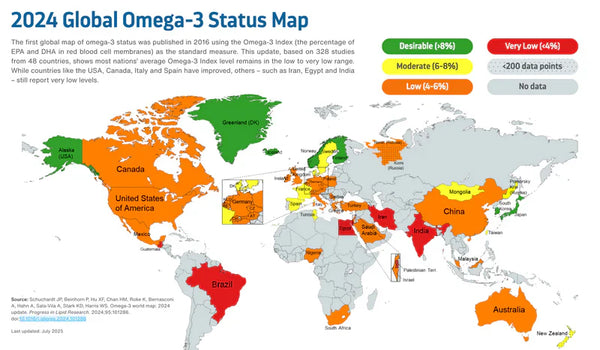
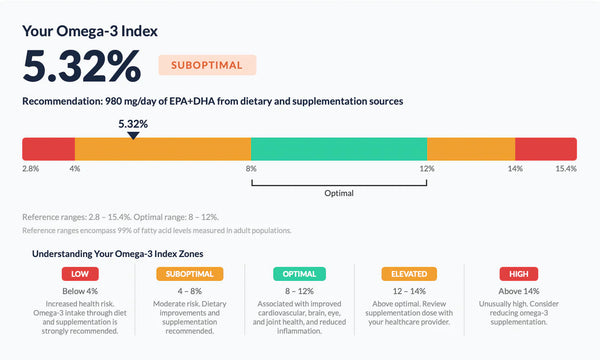
Where the Index is genuinely useful is in telling you where you stand. Rather than guessing from your diet, it measures your actual EPA and DHA level on a scale (optimal 8–12%) that's used across the research. Most UK adults sit below that range, so for many people there's a real, measurable gap to consider — with their doctor where appropriate.
What UK guidance recommends
The NHS and the Scientific Advisory Committee on Nutrition (SACN) advise at least two portions of fish a week, one of them oily, and the British Heart Foundation includes oily fish as part of a heart-healthy eating pattern. Food first is the sensible starting point; our seafood guide shows which fish deliver the most EPA and DHA, and how much you need covers targets if you're topping up.
What this means for you
The reasonable, evidence-based position is: eat oily fish in line with UK guidance, know your Omega-3 Index rather than assuming, and make any decisions about supplements or medication with your GP. Testing doesn't promise an outcome — it gives you and your doctor an accurate number to work from.
Frequently asked questions
Does omega-3 prevent heart disease?
The evidence is mixed and doesn't support that claim. A higher Omega-3 Index is associated with better cardiovascular markers, but omega-3 is not a proven treatment or preventive medicine.
Should I take fish oil for my heart?
That's a decision for your GP, especially if you have heart disease or risk factors. UK guidance favours getting omega-3 from oily fish first.
How does the Omega-3 Index relate to heart health?
It was developed as a risk marker and is associated with cardiovascular outcomes in observational research — useful for knowing your status, not for diagnosing or treating anything.
How much oily fish should I eat?
UK guidance is at least two portions of fish a week, one of them oily.
Know your number, then talk to your GP from facts.
Check your Omega-3 Index →References
- Harris WS, von Schacky C. The Omega-3 Index: a new risk factor for death from coronary heart disease? Preventive Medicine. 2004;39(1):212–220.
- Scientific Advisory Committee on Nutrition (SACN). Advice on fish consumption. 2004; NHS Eatwell guidance.
- British Heart Foundation — fish, omega-3 and heart health guidance.
- Stark KD, et al. Global survey of the omega-3 fatty acids in healthy adults. Progress in Lipid Research. 2016;63:132–152.
This article is general information, not medical advice, and the test is not a diagnostic test. Do not start, stop or change any medication based on it. Always discuss significant health decisions with your GP or cardiologist.
Know your number.
A simple at-home finger-prick test, posted to your door. Find out where you actually stand on omega-3.
See our tests